

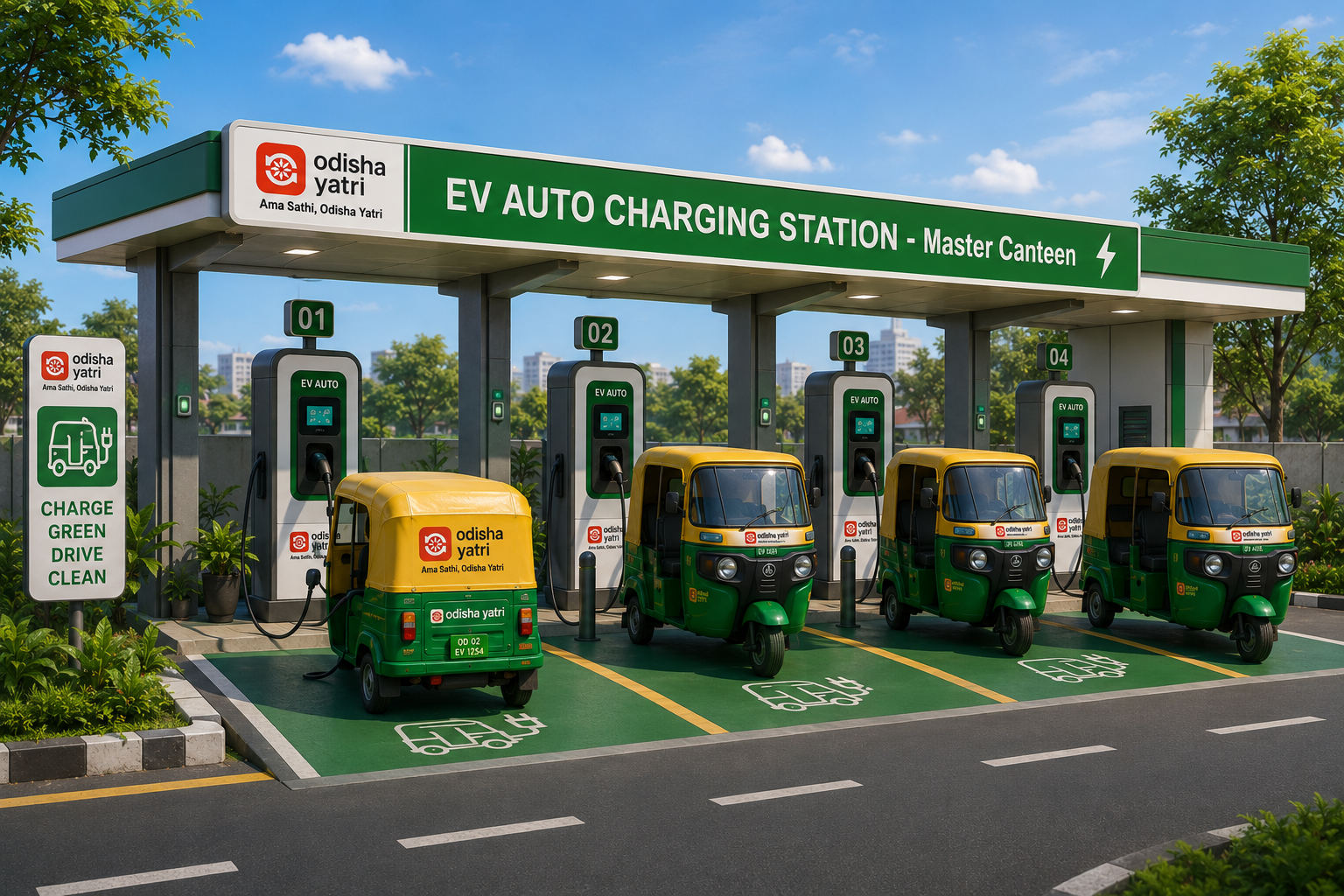
Replacing Every Auto with an EV Could Transform Bhubaneswar
Bhubaneswar has an opportunity to become India's first major city with a fully electric commercial auto-rickshaw fleet. Replacing approximately 30,000 autos with EVs would require an investment of about ₹1,300 crore while adding only around 35 MW to the city's peak electricity demand—well within manageable limits through distributed residential charging and a network of 300 strategic fast chargers
Replacing Every Auto with an EV Could Transform Bhubaneswar- - At a Cost of ₹1,300 Crore
Study Indicates City's Power Grid Can Support Full Electric Three-Wheeler Transition
Bhubaneswar could replace its entire fleet of approximately 30,000 commercial passenger auto-rickshaws with electric vehicles by adding only about 35 MW to the city's peak electricity demand, according to an independent technical and economic assessment. The transition would require an estimated investment of ₹1,250–1,300 crore, including charging infrastructure, while substantially reducing fuel consumption, operating costs, and urban air pollution.
Electricity Demand Remains Manageable Despite Fleet-Wide Conversion
The assessment estimates that each electric auto would consume approximately 7.5 kWh of electricity per day, assuming an average daily travel distance of 100 kilometers. Collectively, the fleet would require about 225 MWh of electricity each day, equivalent to approximately 82 GWh annually.
If most vehicles are charged overnight through staggered charging schedules, the additional peak load on the electricity network would be approximately 35 MW. Relative to the overall electricity demand of the Bhubaneswar urban area, this increase is considered technically manageable, provided charging infrastructure is planned alongside distribution network upgrades.
Assume 80% of vehicles charge overnight over 8 hours from residential connection, it would significantly distribute the load through out the city. Balance load would require an estimated 250-300 public fast-charging points distributed across major transport corridors, commercial centers, railway stations, bus terminals, and high-demand residential areas.
Energy Consumption
Per vehicle : 100 km/day × 0.075 kWh/km = 7.5 kWh/day
Entire Fleet : 30,000 × 7.5 = 225,000 kWh/day = 225 MWh/day
Peak Load Calculation
Assume 80% of vehicles charge overnight over 8 hours.
Night Charging Load : 24,000 × 7.5 = = 180 MWh
Average charging load : 180/8 = 22.5 MW
Remaining daytime charging ≈ 10 MW
Total additional peak demand ≈35 MW
For comparison:
Bhubaneswar city peak electrical demand is several hundred megawatts, so an additional 35 MW is manageable with planned charging infrastructure.
Charging Infrastructure
Assumptions : One fast charger serves 20 autos/day
Required chargers for 20% of 30,000 = 6000/20 = 300 Fast Chargers
Proposed EV Charging Stations
|
Location |
Chargers |
|
Phase-I (High Priority) |
|
|
Baramunda ISBT |
20 |
|
Railway Station (Platform 6) |
10 |
|
Master Canteen |
20 |
|
Kalpana Square |
20 |
|
Rasulgarh Square |
10 |
|
Patia Square |
10 |
|
KIIT Square |
10 |
|
Jayadev Vihar |
10 |
|
CRPF Square |
10 |
|
Khandagiri Square |
10 |
|
Biju Patnaik International Airport |
10 |
|
Kalinga Vihar |
10 |
|
Phase – II (Medium Priority) |
|
|
Chandrasekharpur |
5 |
|
Damana Square |
5 |
|
Sahid Nagar |
10 |
|
Mancheswar Industrial Estate |
10 |
|
AIIMS Square |
10 |
|
Pokhariput Square |
5 |
|
Lingaraj Railway Station |
10 |
|
Bharatpur Square |
5 |
|
Subudhipur Square |
5 |
|
Jadupur Square |
10 |
|
Phase-III (Expansion Priority) |
|
|
Nandankanan |
10 |
|
Phulnakhara Square |
10 |
|
Hanspal Square |
5 |
|
Pandara |
5 |
|
Lingipur |
10 |
|
Gothapatna Square |
5 |
|
Info Vally |
10 |
|
Jatni Gate |
10 |
Lower Operating Costs Offset High Initial Investment
The largest financial hurdle remains the initial capital investment. At an estimated purchase price of ₹4 lakh per electric commercial auto, replacing the entire fleet would require approximately ₹1,200 crore for vehicles alone. Charging infrastructure is expected to add another ₹75-100 crore.
Government incentives would reduce part of the acquisition cost. Under Odisha's current electric vehicle policy, eligible electric three-wheelers qualify for a subsidy of up to ₹30,000 per vehicle, lowering the direct financial burden on operators and fleet owners.
Despite the high upfront expenditure, operational economics favor electrification. The assessment estimates that electric autos would reduce daily energy and maintenance costs from roughly ₹680 to about ₹135 per vehicle, generating savings of approximately ₹545 per day. Over a full year, each driver could save nearly ₹2 lakh in operating expenses, depending on vehicle utilization and electricity tariffs.
At the city level, replacing conventional fuel-powered autos could eliminate the consumption of nearly 55 million litres of petrol annually. After accounting for electricity costs, the net reduction in annual energy expenditure is estimated at approximately ₹490 crore.
The environmental impact is similarly significant. The conversion could reduce carbon dioxide emissions by an estimated 126,000 tonnes each year while eliminating tailpipe emissions that contribute to particulate pollution and nitrogen oxide concentrations in densely populated urban areas.
Transport planners note that successful implementation would depend not only on vehicle procurement but also on coordinated investment in charging infrastructure, grid capacity, financing mechanisms for drivers, battery lifecycle management, and phased fleet replacement. Without these complementary measures, the economic and operational benefits projected by the assessment may not be fully realized.
As Bhubaneswar continues to expand and vehicle ownership increases, the findings indicate that large-scale electrification of public intermediate transport is technically feasible. The principal challenge lies less in electricity availability than in mobilizing capital, building supporting infrastructure, and executing the transition in a financially sustainable manner.
Proposed Roadmap for Complete Electrification of Commercial Auto-Rickshaws in Bhubaneswar
Phase 1: Develop a Comprehensive EV Charging Network
The Government should establish a city-wide charging infrastructure before initiating fleet replacement. Fast and slow charging stations should be strategically located at major transport hubs, railway stations, bus terminals, markets, residential clusters, commercial districts, and designated auto stands. The charging network should be designed to support future growth in electric mobility beyond the auto-rickshaw segment.
Phase 2: Fleet Acquisition and Replacement
The Government should undertake a one-time acquisition of the existing commercial auto-rickshaw fleet. Every registered commercial auto owner would surrender their existing petrol, diesel, or CNG vehicle and receive a new electric auto-rickshaw upon making a one-time contribution of ₹50,000. The balance cost of the vehicle would be financed or borne by the Government through a combination of subsidies, institutional financing, and green mobility funding. This approach would ensure rapid fleet conversion while minimizing the financial burden on individual drivers.
Phase 3: Establish a Zero-Emission Urban Transport Zone
Following completion of fleet electrification, the Bhubaneswar Municipal Corporation (BMC) area should be declared a Zero-Emission Passenger Transport Zone for commercial three-wheelers.
§ Only electric commercial auto-rickshaws should be permitted to operate within the BMC limits.
§ Commercial petrol, diesel, or CNG auto-rickshaws entering from outside the city should be permitted only upon payment of an Urban Clean Mobility Entry Fee per day basis.
§ The entry fee would encourage adoption of electric vehicles while generating revenue to support the city's EV infrastructure and maintenance.
Phase 4: Digital Integration and Cost Recovery
All electric commercial auto-rickshaws should be mandatorily integrated with the Odisha Yatri App, creating a unified digital mobility platform for passengers and operators.
To recover the Government's investment, a mobility recovery charge should be deducted automatically from driver earnings through the platform. The deduction shall be the lower of 25% of the trip commission or ₹500 per day, and will continue only until the Government has recovered the cost of the vehicle. Based on current operating economics, the investment is expected to be fully recovered within approximately three years, after which the deduction would cease and the operator would retain the full earnings.
Expected Outcomes
§ 100% electrification of Bhubaneswar's commercial auto-rickshaw fleet.
§ Significant reduction in urban air and noise pollution.
§ Lower operating costs and higher net income for drivers.
§ Reduced dependence on fossil fuels and improved energy security.
§ Increased adoption and utilization of the Odisha Yatri platform.
§ A financially sustainable model that enables Government investment to be recovered and reinvested in future urban mobility initiatives.
Thought
Ar.Subhakankhi Choudhury
Bhubaneswar.